
Our European leadership, the Eurobureau, is worried that the debt crisis ‘might’ spread from the nations they like to call peripheral, to those regarded as central – France, Spain, Italy and Germany. Please file that one under ‘No Shit Sherlock.’
Who would have guessed? But while attention is finally, months too late, finally focused on Spain and Italy – and especially on Italy where a real blow out may be close – I think it’s the storm waves heading East not West that may be the next surprise our experts didn’t see coming.
Confidence that Europe’s leaders have any plan at all is all but gone. They have successfully simpered and shuffled to a place from which there is now no exit. To pursue their idiot policy of saving the French, German and Italian banks – which is what bailing out Greece is really about – they have to have a far larger European Bail out fund – the EFSF. But they have not a single idea of how they can make it bigger. Who will pay for a bigger bail out fund? The Germans? Merkel cannot push that upon her people. There is enough resentment in Germany to start a small war already. They cannot go to the markets and borrow hundreds of billions. The markets won’t lend it to them at any rate which is workable and in the present moment some might not wan to risk even asking the markets just in case they said no, which really would be the end of the official policy. So that leaves printing. Which would end in catastrophe as the Euro fell through the floor. But because it might be a choice between dying today or next week, printing is what they might go for, if some more warm euro-waffle words about creating a larger fund , pledging unity, standing together etc, etc, doesn’t quite fool the same fools twice.
Of course some might say, who cares if the Euro sinks, it helps Germany’s exporters and they are frankly our last best hope. But this forgets one little thing. As the Euro sinks, as confidence in the official ‘bail out and save the banks from their own debts’ plan fails, and is seen to fail, money is leaving the euro and leaving the euro zone. You only have to look at the exchange rate of the Swiss Franc to see where all the money is going. I wonder how many billions left Italy’s banking and financial system yesterday alone and went to Switzerland and its currency.
The flood got so serious yesterday that the Swiss Central bank cleared its throat and its pale hand moved toward the ‘Intervention’ button – interbank lending rates were lowered – a kind of Swiss QE – and the Franc started to lose some of its accumulated value. For about an hour. Then it went right back to the trajectory it had been on. And what trajectory was that? Well here is what it was against the Hungarian Florint.
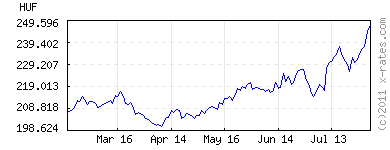
And what does this mean? Yesterday it took more Hungarian Florint’s to pay off one Swiss Franc’s worth of a mortgage than ever before. Every mortgage and government loan taken out in the good times in Swiss francs became more unaffordable than ever before,
More Hungarian loans and mortgages are going to default. How many more, how much more serious is their debt problem against a Swiss Franc constantly increasing in value? This hit the headines the same day,
Increasing debt service has prompted the Alliance of Local Governments to appeal to Prime Minister Viktor Orbán requesting measures that would allow cities to defer the start date of debt redemption by one year, Chairman György Gémesi said in a public radio interview.
Defer redemption? What’s a defered redemtion?
Local governments’ request for a grace period … essentially amounts to debt restructuring,
Said Royal Bank of Scotland emerging markets analyst Timothy Ash. And restructuringnis default!
And so CDS insurance against Hungarian default jumped up taking Hungary’s borrowing costs, and those of its banks, up with it. And so to round out a nightmare day not of their own making – one which crashed on their shores like Hurricane Europa – we also had Hungary’s largest bank OTP bank lose 5% of its value in one day.
OTP can’t sustain those sort of losses. If the Swiss franc stays where it is, let alone gets any stronger, then Hungary’s banks and Hungary itself is done, cooked, crisped and ready for the bin. Their ‘recovery’, their ‘projected growth’ and their austerity programme will all fall over within the year.
If OTP bank were to collapse under a weight of defaulted loans or too much blood loss on its share price it would take down a swathe of Eastern European banking. According to Wikipedia,
OTP Group currently operates in 8 countries of the region via its subsidiaries: in Bulgaria (DSK Bank), in Croatia (OTP banka Hrvatska), in Romania (OTP Bank Romania), in Serbia (OTP banka Srbija), in Slovakia (OTP Banka Slovensko), in Ukraine (OTP Bank JSC), in Montenegro (Crnogorska komercijalna banka) and in Russia (OAO OTP Bank).
OTP is partly a Nationalized bank. The Hungarian government is propping it up. Who would cover deposits in all those subsidiaries? Hungary? The rich nations in which it operates?
The other large banking players in the region are the Greek banks, and UniCredit via Bank Austria.
The global powers have little time to make their stupid policy work a bit longer. If they don’t and the global sell off continues we will soon get to the point where Money Market and Hedge Funds will get so many requests for redemptions (people wanting their money out) that they will have no cash with which to pay them and will either have to lock them out (akin to a bank locking its doors) or they will have to start selling assets in order to raise the cash.
As they try to sell in to a falling market it will accelerate the collapse in price of the very assets they are trying to sell. Just today the Dow lost 500 point! That’s 4.3% down in a day. The Nasdaq lost 5%. Every European bourse and London were all over 3% down. That is all on top of the losses earlier in the week which were already BIG. What if Asia follows on and the tide ripes round and back to Europe in the morning and America again in the afternoon, and the falls continue?
That is the nightmare scenario they are facing if this sell off continues tomorrow and on in to next week.
Couldn’t possibly happen could it? Of course not. The people with their hands up our politicians, working their mouths for them, are the smartest men in the room aren’t they?
I expect major stupidity to be announced next week. When it is, feel your wallet get lighter as the banks and their political friends thieve from it once again.
Friday Morning UPDATE: The Nightmare does continue.
Nikkei down 359 points/3.72%.
The Hang Seng down 1126 points /5.14%!
AND EUROPE drops in 5..4..3..2..1 and
London opens with a verticle drop of 2.98% down.
Paris 3.9% down
Frankfurt 3.4% down
I have one further thing to add to this and it goes out mostly to all those who marched us into this and who will refuse to admit they are lost and wrong and will continue with their failed policies.

There is some irony in the fact that the same people who extolled the unfettered movement of capital which fuelled the boom years now try to pretend that the fall-out can be compartmentalised and the contagion 'contained'. It's a well-used image but the metaphor of the 'water-tight' sections on the Titanic that only went half way up seems an apt one. Still, the orchestra keeps playing (is that 'Songe d'Automne' I can hear?).
The 'market' will simply continue to prise open the weakest links – even though its participants are ultimately dependent on the chain. The major financial institutions are doomed to drive this policy as they try to pretend they can recover their own share of the global debt, but domino austerity can't possibly rescue them.
Charlie,
Well said. Agreed in full.
Golem
It's all looking like collapse is getting nearer & another great post from you here has added more information supporting that view.
One thing tho'. I think you really need to revisit your views on 'printing' or QE & in particular the notion that it must always result in excess inflation & hence is not an option.
The MMT economists are absolutely clear that in a recession situation with massive under utilisation of labour and other resources, excess inflation will not occur. There is a proviso. It must be done in the right way – thru' carefully targeted direct public spending into the economy in a way that does not crowd out existing private sector activities. 'Green' infrastructure is the obvious focus. This is why Richard Douthwaite (feasta.org) termed his proposal 'qualitative' easing to distinguish it from 'conventional' 'quantitative' easing which just gifts more more money to the bansters casino & does eff-all for the real economy. (Which is what US & UK has already done.)
There are a couple of minor inflation dangers with this. The first is oil. The price could, probably will, rise at the first sniff of consumer demand growth. But we can't do much about this except try to concentrate economic growth away from consumer junk & into de-carbonising investment.
The second is thru' less than perfect spending programs. Sure, this might happen, but I think we better ask our small saver pensioners etc. whether they want to eat or try to preserve a few odd percent on their savings. That's going to be the choice.
It's possible the Euro might devalue initially – probably the market vultures will have a go. Some inflation may arise from that, mainly due to oil, tho' governments could reduce their taxation on it. But once markets see that there is a real plan to counter austerity, degrowth & spiralling unserviceable debt – a credible way out the mess by reviving the +only+ source of wealth creation, the real economy, d'you really think they'll prefer debt loaded, tanking $ or £ economies? Lets be honest, such a plan wouldn't need to be that hot to be better than where they +know+ we're heading now.
Sure, it's not likely the moron 'authorities' will cop on anytime soon, but we need a sane plan post crash, right?
mikehall,
I find a great deal of sense in everything you wrote.
I tend to agree that if money is pput in to the economy, the real economy, in order to create new employment and wealth producing/waste and energy reducing activity then it will do good and teh inflatinary pressure may not be that great. Which if I am not mistaken is what Keynes actually said. He did not say, to my knowledge that giving money to insolvent banks was his idea of countercyclical spending.
All the cries of the failure of Keynes, by those who want to justify cuts, are pure, knowling lies, since what has been done to bail out the bank is not Keynesian at all.
The inflationary result I meant was the result of our printing and spending of vast sums of money on the banks as we have done. I agree, if spent otherwise, the results would be very different.
The spending done so far has been massively inflationary because so much of it has recently gone in to commodity speculation and currency speculation often flooding markets such as Brazil who can do little to stop it.
I will read more of MMT. Promise.
''All the cries of the failure of Keynes, by those who want to justify cuts, are pure, knowling lies, since what has been done to bail out the bank is not Keynesian at all.''
Golem I couldn't agree more. I've been saying for the past year or so that QE is not Keynsian in reply to those who insist the US stimulus was (it was only a small part of what he'd suggest in a possible deflationary crisis) just using QE and not real fiscal stimulus is pure Chicago School.
I've never been as angry as I felt tonight watching the talking heads they wheeled out on news show after news show – all pontificating on how the West was doomed due to governments, tax, regulation, blah blah blah,. And these were all the speculators causing the damned problems in the first place.
I wouldn't be surprised if at some point, someone, somewhere goes the whole hog and just implements really aggressive protectionist measures, then here we go 1930's all over again. Of course if we'd never abandoned the rather sensible post war agreement in favour of 'moving money around the world so fast it doesn't touch the sides' (Robert Peston) then we might not be facing that possibility.
Golem have you read David Harveys The Enigma Of Capital by the way? I keep meaning to ask you. it's a brilliant book I think.
I agree, the scapegoating of keynes is unbeliveable. But seems to be working this crisis is being PR repackaged as a crisis of socialism rather than capialism
On another note, i have been trying to imform as many folk as possible about fractional reserve banking, even to the extent of engaging in conversations with compleat strangers in coffee queues. Strangely no one is surprised but all seem to be quite fatalities about it. I find this disturbing, it seems that even if people know the truth they feel that it's not their place to question it. Who needs whips and chains to enslave when people have them in their heads
Richard,
In every cry of every man,
In every Infant's cry of fear,
In every voice, in every ban,
The mind-forged manacles I hear.
From "London" by WIlliam Blake
Princesschipchops,
I am sad to say I have not read The Enigma of Capital though I would very much like to. An earlier book of his Postmodernism is wonderful. If ever I can catch up a little on my reading list I will certainly read it and would love to hear more of your thoughts on it.
Gillian Tett of the FT:
"another ghost of 2008 returns: short-term funding risks. As a brilliant paper from the Peterson Institute points out, the structure of the eurozone system has encouraged its financial institutions to become heavily reliant on short-term funding; the 90 banks covered by the recent European Banking Authority stress tests, for example, need to refinance €5,400bn of debt in the next two years, equivalent to 45 per cent of European Union gross domestic product. Until recently, it was easy to roll over these funds because of the implicit moral hazard in the eurozone (it was assumed nobody would default) – now this assumption has cracked. There is thus a rising risk of an accelerating capital flight. Short-term funding could yet dry up, as it did for dollar-structured investment vehicles in 2007, and Bear Stearns and Lehman Brothers in 2008. Particularly since the unpredictable actions of credit rating agencies are – once again – fuelling market fears. "
http://www.telegraph.co.uk/finance/financialcrisis/8680820/Debt-crisis-live.html
Neil,
thanks for that Gillian Tett is I think the sharpest of them all.
We're heading straight into another AIG/Lehmans collapse. More cries of – its just a liquidity problem will be chorused to drown out anyone mentionaing actual solvency.
Your comment over on "Fanfare of Failure" about inflation and a sovereign's ability to print was interesting. I have questions and issues I'd love to discuss.
Hi Golem,
The Enigma of Capital is one of four books I reccommend to everyone along with yours, Whoops by John Lanchester and The Last Oil Shock.
David Harvey has the same view as Lanchester – that basicaly a war was fought between financial capital and industry and finance won in the late seventies and then set us on this course (Simon Johnson says similar stuff too).
Harvey then goes on to explain that a recession – a normal industrial recession is indeed cyclical and not a huge crisis and gives examples from the fifties and sixties and seventies. He contests that a lot of what we've seen in the eighties, nineties and now are not really recessions. They're ever worsening financial crises. He talks about how the noughties were a lost decade for equities. About how a lot of the crises like Russia's near collapse and the tech stocks collapse and Enron, were structural crises of a corrupt system. And that every time these crises occur jobs go – never to come back again. So unlike earlier manufacturing recessions, when we 'recover' we always recover with more structural unemployment.
He then talks about how there won't be a return to 'normal'. And that unemployment will grow and grow as the next decade is one fraught with crisis after crisis. He basically ends by saying if we don't fight back and change the system it will take us down because no way will the elite, the bankers, the capitalists – call them what you will – let go.
Fear not Golem, great minds are at work as I sit here in Finland Airport wondering if I should turn round and head straight back to Nanning and lie down in a dark room for the next 5 years.
As Spain and Italy lurch to within a few basis points of national debt failure the ECB has made a bold and decisive move in the bond markets and purchased….. Irish and Poruguese bonds.
Who the fuck is writing this script Monty bloody bleeding Python? More QE on a European and/or American scale will just release a new tsunami of hot inflows into the bricks and drive up further commodity prices.
Well I have news for these bloody geniuses. China and Russia, to name but two, are not going to stand for it again. And so the game of beggar thy neighbour will start in earnest with everybody losing.
The shit has hit the fan, time to duck. bill40
From the Telegraph coverage:
"09.38 Royal Bank of Scotland (RBS) became the third of Britain's major banks to have had trading halted in its shares in the last 24 hours after Lloyds Banking Group and Barclays yesterday.
The shares were temporarily suspended after losing 14pc of their value in early trading, knocking nearly £2bn off the state-owned lender's market value.
In a statement, the London Stock Exchange said:
Quote It is normal procedure in a volatile market for stocks to enter an automatic suspension period when a certain control threshold is breached. The automatic suspension, which sees stocks enter a 5 minute auction period, helps ensure the continuance of an orderly market [sic]."
"08.10 RBS is the biggest Footsie faller this morning. The shares have plummeted 14pc to 26.05p. To put that in perspective, it was trading at 602.6p just before things started to get awry in 2007.
Lloyds Banking Group has fallen 10pc, Barclays is down 9.6pc and HSBC has fallen 1.5pc on the back of the news."
"07.45 RBS boss Stephen Hester spoke to the BBC's Evan Davis this morning on the Today programme, where he said the main priority was being "both calm in the face of all this news, and purposeful".
He also argued that this (and the previous) crisis was not about the banks, but more about governments getting their act together. He said:
Quote I think that we are seeing today what arguably we should have seen better in commentary in 2008, and that is it's not a banking crisis, and it never was, although banks were involved in the crisis, it was one of global economic imbalances in the way that we all collectively deal with our economies.
And in that way we are seeing it more clearly that the root of what is going and the nervousness of what is going on is really about how we manage ouer economies globally and individual, and the confidence measures that go along with it."
No comment.
Robert Peston:
"The response of governments around the world to the financial crisis and recession was to keep or even increase public spending, at a time of falling tax revenues, to compensate for the collapse of household consumption and private-sector investment.
In other words, they ran abnormally high public sector deficits – peaking at deficits in the UK, US and parts of the eurozone at 10% or more of GDP – to prevent a global recession becoming a global depression.
In that sense, it is fair to argue that the recent increases in the public-sector indebtedness of many developed economies is the consequence in large part of the decisions taken in 2007 and 2008 not to let the banks and the financial system collapse.
Arguably the deleveraging of the banks, the shrinkage in their balance sheets, has been transferred to the state.
The overall volume of indebtedness in the economy is therefore still with us – although it has been shuffled from financial sector to public sector.
And if you took the view four years ago that the quantum of debt in the system was unsustainably large, then you would argue that by propping up the banks, the day of reckoning was being postponed, not cancelled."
More here: http://www.bbc.co.uk/news/business-14416959
@Princess
Excellent reading list. (I'd say that Harveys Rise of Neoliberalism is even better and his Limits to Capital is a classic if you fancy something weighty!).
All those books point to this simple fact: the world can’t grow in absolute wealth anymore (owing to energy & resource limts) so the modus operandi since the 1970s has been wealth concentration.
This is all anyone needs to know, to properly understand this crisis.
@neil
Thank heavens Peston has said it as it is:
"The overall volume of indebtedness in the economy is therefore still with us – although it has been shuffled from financial sector to public sector."
Just hope he can say it on prime time TV!
That and the other unspoken phrase "privatised profits and socialised losses".
i found yr blog yesterday. Like a lot of ppl,i am having to take a crash cours in economics.The danger with learning a new language is the change in yr way of thinking, and speaking in order to interact with those in the know .
From my rudimentary understanding of the crisis we are in so far;
this crisis is an extension of 2007 but now, instead of banks failing,its countries that are gonna fail.
The measures adopted in 2007 didnt work.
We asa society are going to be told that the crisis needs more of the same medicine.I would like to think that at that point there is a popular response against the proposal.
One of the bloggers, Richard in Norway, wrote of his experiences in trying to communicate the problem to strangers. Perhaps strangers are not the best ppl to try and explain to, but communicate and convince ppl, and to take on arguments in favour of the status quo is what should be happening now.
Movements like 15 mayo in spain are a positive response. What worries me if desparate ppl start playing the blame game, cos that is what happened before in the 30's. Human nature is still very much the same.
David Harvey ends The Enigma of Capital by asking who will change the system:
"Perhaps we should just define the movement, our movement, as anti-capitalist or call ourselves the Party of Indignation, ready to fight and defeat the Party of Wall Street and its acolytes and apologists everywhere…. The struggle for survival with justice not only continues; it begins anew. As indignation and moral outrage build around the economy of dispossession that so rebounds to the benefit of a seemingly all-powerful capitalist class, so disparate political movements necessarily begin to merge, transcending barriers of space and time."
There is also a neat animation on YouTube to his brief description of the crises of capitalism
http://www.youtube.com/watch?v=qOP2V_np2c0
shaun ohara
and in English…?
Who was that other Olli who used to say " Another fine mess ", although it's all under control, apparently.
http://www.politics.ie/forum/europe/167110-olli-rehn-says-markets-have-not-reacted-expected-efsf-needs-credible.html
Gollum, love the postscript.
@ shaun o Hara
Know what you mean, posted links till I'm blue in the face, I don't think the powers that be have the access to a scapegoat as handy as yer man Hitler had, but I'm sure they'll come up with something for the mob.
Reported in the Guardian live coverage, http://www.guardian.co.uk/business/blog/2011/aug/05/stock-market-crisis-ftse-usa-europe ):
"11.52am: Lisa O'Carroll in Dublin has this update:
Ireland seems to be somewhat insulated from the market meltdown today as Standard & Poor's removed it from its credit watch. S&P said the outlook for its BBB+ rating was stable, meaning it is unlikely to change in the short-term. This means S&P has decided not to follow Moody's, which last month lowered Ireland's debt to junk status.
"The outlook is now stable, reflecting our opinion that the assumptions underlying the stress test…conducted by the Central Bank of Ireland -in conjunction with the IMF, European Central Bank, and European Commission – are robust and that the expected €18-€19bn (11.5%-12.0% of GDP) net cost to the Irish state of additional recapitalization, plus the contingency buffer for the banking system, is within our range of expectations, albeit at the upper end," said its credit analyst Frank Gill.
The agency said it would consider raising the credit rating if the state manages to raise more than 10% of GDP through sale of property now controlled by the state or if growth exceeds S&P's expectations of 2–2.5%."
I'm sure David or Whistleblower will have something to say about that…
Additions to the reading/viewing list:
'How Markets Fail' an excellent overview of the ideological background to post-war economics by John Cassidy.
Much of the debate about the origins of the crisis retains a 'technocratic' approach which masks the ideology driving policy – maintaining a pretence that it was simply a case of disinterested individuals making the wrong choices. But neoliberalism dominates policy not because it offers an approximate mapping of real world economics, but because it serves the interests of the wealthy and most politically powerful. Adam Smith's 'invisible hand' makes the contingent seem inevitable. The idea that individual self-interest must inevitably lead to an optimum allocation of resources neatly satisfies the utilitarians' quest to achieve the 'greatest good for the greatest number' while preserving the individual liberty that a crude majoritarianism would threaten – resulting in the best of all possible worlds. Anyone looking at the developments of the last thirty years, the accelerating inequality, reduced social mobility, and stagnating economy would see that it's nonsense. Cassidy explains why.
Also: George Cooper's 'The Origin of Financial Crises', which elucidates on the ideas of Hyman Minsky is another useful text.
'All the Devils Are Here' by Bethany McLean and Joe Nocera explodes the myth that nobody saw it coming (for instance, the states and cities were desperately trying to outlaw predatory lending years before the bust but were overruled by Greenspan et al).
Satyajit Das's 'Traders, Guns and Money' reinforces this point by giving a traders-eye view of the scams, and Michael Lewis's 'Liar's Poker' provides a useful recap on how securitization came into being – supercharging the debt-creation machine and, fatally, breaking the link between borrower and lender.
Ayn Rand's 'The Virtue of Selfishness' gives a good idea of where Greenspan and his acolytes are coming from.
On video: an essential insight into the battles that went on in Washington as the regulations on finance were hollowed out can be gleaned from: Frontline's 'The Warning' – http://goo.gl/S1TL – which details the failed attempt of Brooksley Born to rein in the worst excesses of the derivatives markets against the triumvirate of Greenspan, Summers and Rubin. 'Lifting the Veil' -http://vimeo.com/20355767 – shows why nothing will change as long as the same people that engineered the crisis are charged with fixing it.
Oh, and 'Debtocracy' – http://youtu.be/qKpxPo-lInk – brings things up to date, while this video – http://youtu.be/rH6_i8zuffs – on Argentina's experience of the IMF medicine shows the tried and tested formula being tried and tested. Max Keiser's entertaining pre-crash romp through Iceland – http://youtu.be/JjglR2KYz5o – offers an entertaining reminder that one of the main casualties of the crash has refused (so far) to be cowed into complete submission by the 'markets' (i.e. the major financial institutions that rig the system) in spite of its role as the overfed canary in the coalmine.
Of course, I should have mentioned Naomi Klein's brilliant 'Shock Doctrine' which puts all the pieces of the jigsaw together.
Newsnight's economics correspondent Paul Mason, blogging on holiday, says much the same as Peston:
"Now what do these combined pressures on the US Treasury, the ECB, Italian and Belgian debt tell us?
That – as I have written here before – when we decided that the state should save freemarket capitalism without anybody taking a serious loss, we simply transferred the losses to the state itself. And some states were not strong enough to bear the loss."
http://www.bbc.co.uk/news/business-14420090
Mind you, of course, "saving free market capitalism" is a contradiction in terms, since it's meant massive state intervention. The "free" market is and always has been a fiction, since to a greater or lesser extent, states always intervene in markets. If they were genuinely free, the banks would have been allowed to fail. Market forces, innit?
Whoa people! I'm away five minutes, I get back and you're…posting a shed load of comments.
I have to make dinner for the small people I just welcomed back home. So I may not get a chance to reply today.
But thank you. Great comments and lots of them. What more could a boy ask for.
…er, at what point does France confess they are as broke as Italy, and they ain't got nuffink in the kitty to offer up, so Germany is on its own as bail-out of last resort?
Where was it I heard or read recently that the only way for the Eurozone to survive was for Germany to leave it? Then the euro could sink down, making the remaining countries' exports more competitive. The problem is that Germany, as the main benefitter from the euro, would have to let its new deutschmark soar upwards, thus making its own exports less competitive. But faced with the choice between doing that and being the chief bailer-out of the PIIGS, they might just go for it.
Telegraph (better coverage than the Guardian):
"20.27 The dramatic spike in the borrowing costs of the Italian and Spanish governments has led Goldman Sachs to downgrade the countries' major banks amid worries that the increase will impact their profitability. The largest downgrade was for shares in Banco Popolare Di Milano, which had their price target cut by 40pc."
22.16 ABC news is reporting that the US is expecting an S&P downgrade tonight:
"A government official tells ABC News that the federal government is expecting and preparing for bond rating agency Standard & Poor’s to downgrade the rating of US debt from its current AAA value.
"Official reasons given will be the political confusion surrounding the process of raising the debt ceiling, and lack of confidence that the political system will be able to agree to more deficit reduction. A source says Republicans saying that they refuse to accept any tax increases as part of a larger deal will be part of the reason cited."
"The official was unsure if the bond rating would be AA+ or AA.
"20.54 Citigroup, the third-biggest US bank, said it has $31.7bn of gross funds at risk in Greece, Italy, Portugal, Spain and Ireland."
A bank admitting how much it has at risk??? Is this manoeuvring for a further bail-out?
@Charlie – that is a great list and some really interesting titles that I'd not heard of. Thanks a lot for posting it. All the Devils are Here sound particuluarly intriguing.
If France is as indebted as it seem and it is Germany that has to bail out Europe well such are the ironies of History. This time its the euros they have to send rolling instead of the Panzers. But they arent going to like it. As you say Golem Merkel hasn't the power to do it and who has the political strength to defy the German Public who are in a resentful mood?
Its hard to see how this will play out….
And now S&P downgrade the US. I actually DIDN'T see that coming. I mean that in all seriousness, it totally surprised me when I turned on the news this morning. I wonder if Fitch etc will now follow too?
Apparently according to The Guardian and others there was a lot of pressure – a lot of pressure – from Washington not to do it. And now Washington are saying that there is a $2 trillion hole in their calculations.
What with that and ratings agencies offices in Milan being raided I am reminded of what you said Golem a while ago in a post, about everyone turning on one another.
Federal Europe is worth it, though?
August 5, 2011, 9:19 PM
S&P and the USA
OK, so Standard and Poors has gone ahead with the threatened downgrade. It’s a strange situation.
On one hand, there is a case to be made that the madness of the right has made America a fundamentally unsound nation. And yes, it is the madness of the right: if not for the extremism of anti-tax Republicans, we would have no trouble reaching an agreement that would ensure long-run solvency.
On the other hand, it’s hard to think of anyone less qualified to pass judgment on America than the rating agencies. The people who rated subprime-backed securities are now declaring that they are the judges of fiscal policy? Really?
Just to make it perfect, it turns out that S&P got the math wrong by $2 trillion, and after much discussion conceded the point — then went ahead with the downgrade.
More than that, everything I’ve heard about S&P’s demands suggests that it’s talking nonsense about the US fiscal situation. The agency has suggested that the downgrade depended on the size of agreed deficit reduction over the next decade, with $4 trillion apparently the magic number. Yet US solvency depends hardly at all on what happens in the near or even medium term: an extra trillion in debt adds only a fraction of a percent of GDP to future interest costs, so a couple of trillion more or less barely signifies in the long term. What matters is the longer-term prospect, which in turn mainly depends on health care costs.
So what was S&P even talking about? Presumably they had some theory that restraint now is an indicator of the future — but there’s no good reason to believe that theory, and for sure S&P has no authority to make that kind of vague political judgment.
In short, S&P is just making stuff up — and after the mortgage debacle, they really don’t have that right.
So this is an outrage — not because America is A-OK, but because these people are in no position to pass judgment. paul krugman blog
Perhaps we need to confiscate the wands from our financial wizards.
A six month(six year? time doesn't matter once you have started the exposure) moratorium with just enough money circulating to keep domestic retail and industry going.
Meanwhile all the fancy double, treble and probably quadrupled squared stuff of hedges, derivatives, bonds, primes subs and otherwise, fractionals reserved and unreserved, the totes and tits of credit ratings. the de-de- defaultering defaults, the talking in tongues to camouflage myth with mystique should be brought to a halt and under a moratorium ruthlessly audited until we know exactly what – if anything – is due to anybody – which may be nothing, or very little – and who is liable to whom and for what?
And was it worth, or in any way warrant all the fuss?
Because, at the end of the day it we don't actually prove and expose this liquidised toxic sludge is a scam – a deadly scam, a plastic plague created by and for confusion of digits, zeros and ones, the digital bullets that kill, maim and lay waste, covert and bloodless never staining the hands or conscience of its tyrannical Tribunes.
These Emperors really have no clothes -it's time we started jeering at them.
richard in norway,
It's not just me that talks to complete strangers then!
Thank fcuk for that.